Sled Training for Adults: Benefits, Workouts & How to Start
One of the most effective and joint-friendly tools in fitness, the training sled delivers full-body conditioning for adults at every level.
Introduction
Mark, 52, had spent years cycling through gym machines without ever feeling like his workouts were truly challenging his whole body. Then his physical therapist introduced him to sled training during rehabilitation for a knee injury — and within eight weeks, his strength, cardiovascular endurance, and even his knee stability had measurably improved.
His experience is far from unique. According to the American College of Sports Medicine, functional strength training — which sled work exemplifies — is consistently ranked among the top fitness trends for adults in the United States. Despite that, the sled remains one of the most underutilized pieces of equipment in most gyms.
In this guide, you’ll learn what sled training is, why it’s particularly well-suited for adults aged 30 to 70, what the science says about its benefits, how to get started safely, and how to build a progressive program that fits your health goals. Whether you’re managing a chronic condition, returning from injury, or simply looking for a more effective workout, sled training deserves a serious look.
What Is Sled Training?
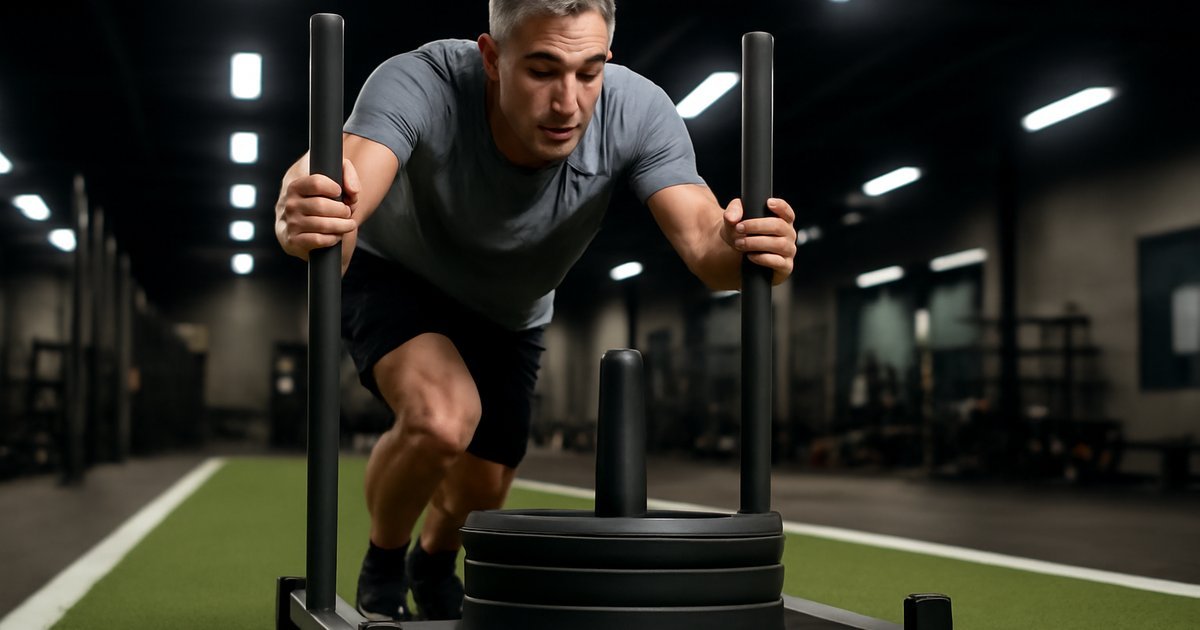
Sled training involves pushing or pulling a weighted sled across a surface — typically turf, rubber flooring, or pavement. The sled itself is a simple piece of equipment: a flat platform on runners with vertical posts where weight plates are loaded. You can push it forward, pull it backward, drag it laterally, or attach a harness for whole-body resistance work.
Unlike most gym equipment, the sled provides concentric-only muscle contractions — meaning your muscles shorten under load without the lengthening phase (eccentric contraction) that causes the most post-exercise soreness. This makes it uniquely gentle on joints and connective tissue while still delivering a powerful training stimulus.
In the United States, sled training originated in strength and conditioning programs for football and track athletes. Today, clinical research supports its use for general fitness, metabolic health, and rehabilitation across a much broader population — including older adults and those managing conditions such as hypertension, Type 2 diabetes, and osteoarthritis.
The NIH’s National Institute on Aging emphasizes that adults over 50 benefit greatly from progressive resistance exercise that minimizes injury risk. The sled checks both boxes: it builds strength progressively while placing minimal stress on joints compared to traditional barbell or machine exercises.
Signs You Might Benefit from Sled Training
Sled training doesn’t come with a specific set of "symptoms" that indicate you need it — but there are clear patterns in a person’s fitness profile that suggest it would be highly beneficial:
- Low cardiovascular endurance — you feel winded quickly during moderate activity
- Weakened lower body strength — difficulty climbing stairs, rising from chairs, or walking long distances without fatigue
- Joint discomfort with traditional weights — squats, lunges, or deadlifts aggravate your knees or hips
- Post-injury deconditioning — you’ve lost strength after surgery or extended inactivity
- Metabolic health goals — you want to improve blood sugar regulation or cardiovascular markers
- Plateau in current training — your existing routine has stopped producing results
- High DOMS sensitivity — severe muscle soreness after exercise that disrupts your daily life
A 2022 review published in the Journal of Strength and Conditioning Research found that resisted sled pushing significantly improved both aerobic capacity and lower-extremity power in adults with varying fitness levels, suggesting broad applicability across age groups.
Causes of Fitness Decline in Adults — and How Sled Training Addresses Them
Understanding why fitness declines with age helps explain why sled training is particularly well-matched to adult physiology.
Sarcopenia — the age-related loss of muscle mass — begins as early as your 30s and accelerates after 60. According to the NIH, adults lose approximately 3 to 8 percent of muscle mass per decade after age 30, with losses accelerating after age 60. This contributes to weakness, metabolic slowdown, and increased fall risk.
Reduced cardiovascular efficiency also occurs with age. The heart’s maximum output declines, and blood vessels become less elastic, raising cardiovascular disease risk. The CDC reports that heart disease remains the number one cause of death in the United States, responsible for one in five deaths.
Joint degeneration affects roughly 32.5 million US adults living with osteoarthritis, per CDC data. Traditional high-impact or eccentric-heavy training can worsen joint symptoms in this population.
Sled training directly counters all three of these factors: it builds and preserves muscle mass through loaded resistance, improves cardiovascular output through sustained effort intervals, and does so without the eccentric loading that stresses articular cartilage. It’s one of the few training modalities that genuinely bridges the gap between strength work and cardiovascular conditioning.
How to Get Started: Sled Training for Beginners
Starting sled training is simpler than most people expect. Here’s what to consider before your first session:
Equipment and Space
Most commercial gyms with strength areas have at least one sled. Some gyms have dedicated turf lanes specifically for sled work. If you’re setting up at home, a basic sled with a turf section or smooth concrete surface works well. Indoor rubber turf sleds can also work on outdoor pavement with appropriate runners.
Starting Load
Clinical exercise physiologists typically recommend beginners start with body weight equivalent or 25 to 50 percent of body weight as the working load. Your form and breathing should remain controlled throughout each push or drag. If you can’t maintain an upright or slightly forward-leaning torso, the load is too heavy.
Session Structure for Beginners
- Warm-up: 5 minutes of light walking or dynamic mobility (hip circles, leg swings, ankle rotations)
- Work intervals: 20 to 30 meters per push, 4 to 6 sets, 90 seconds rest between sets
- Cool-down: 5 minutes walking, followed by static stretching of the calves, hamstrings, and hip flexors
- Frequency: 2 sessions per week with at least 48 hours between sessions
Because sled training causes minimal muscle damage, many adults find they recover significantly faster than after conventional weight training — often within 24 hours. Research suggests this makes it an excellent option for adults who want to train more frequently without accumulating excessive fatigue. For additional recovery strategies, see our guide on Stretching & Mobility Training: Benefits & How to Start.
Core Sled Exercises and Progressions
The versatility of the sled is one of its greatest strengths. Here are the foundational movements, organized from beginner to intermediate:
Beginner Movements
Forward Sled Push: Hands on the vertical posts, lean into the sled at a 45-degree angle, drive through your legs in short powerful strides. Targets the quadriceps, glutes, calves, and core.
Backward Sled Drag: Attach a strap or rope, face away from the sled, and walk forward pulling the sled behind you. This uniquely targets the VMO (the teardrop-shaped muscle above the knee) and is widely used in knee rehabilitation programs.
Low Handle Push: With handles lowered to hip height, push the sled while maintaining a more horizontal body angle. Increases core and upper back engagement.
Intermediate Movements
Lateral Sled Drag: Attach a strap to one side of your body and walk sideways, engaging the hip abductors and adductors. Excellent for hip stability and fall prevention.
Sled Row: Face the sled with a long strap, lean back slightly, and drive your elbows back to pull the sled toward you. Targets the upper back, biceps, and rear deltoids.
Sled Sprint: A short, explosive push at maximum effort for 10 to 15 meters. Builds power, anaerobic capacity, and metabolic conditioning. Reserve this for those with a solid base of training.
For adults who also want to complement their sled work with upper-body pulling strength, Cable Machine Workouts: Benefits & How to Start is an excellent pairing resource.
Health Benefits of Sled Training — What the Research Shows
The clinical case for sled training in adults is growing. Here are the evidence-supported benefits:
Cardiovascular health: A 2021 study in the Journal of Human Kinetics found that resisted sled pushing at moderate intensity produced heart rate responses comparable to high-intensity interval training, suggesting meaningful cardiovascular benefit without the joint stress of running or jumping.
Lower body strength and power: Multiple trials have demonstrated improvements in quadriceps strength, hip extension power, and overall functional mobility in adults performing sled-based programs over 8 to 12 weeks.
Metabolic benefits: Sled training has been associated with improved insulin sensitivity and favorable changes in body composition — reduced fat mass with preserved or increased lean mass. This is particularly relevant for the 96 million American adults with prediabetes, according to the CDC.
Reduced DOMS and faster recovery: Because the sled eliminates eccentric muscle loading, delayed onset muscle soreness (DOMS) is dramatically reduced. This makes sled training one of the most accessible high-effort exercise modalities for adults who need to stay active consistently.
Functional mobility and fall prevention: Sled training closely mirrors the mechanics of walking, stair climbing, and carrying loads — all essential functional movements. The American Geriatrics Society recommends functional strength training specifically for fall prevention in older adults.
Living With Chronic Conditions — Sled Training as a Safe Option
Many adults in the 30 to 70 age range are managing at least one chronic health condition. Sled training’s unique mechanical profile makes it compatible with several of these situations, but individual medical clearance is always necessary.
For adults with hypertension: Moderate-intensity sled pushing elevates heart rate into the aerobic training zone without the breath-holding (Valsalva maneuver) commonly seen with heavy barbell lifts. Most physicians and the American Heart Association support moderate aerobic and resistance exercise for blood pressure management. Always confirm with your cardiologist or primary care provider before starting.
For adults with Type 2 diabetes: Resistance exercise improves glucose uptake in muscle tissue. Sled training combines both cardiovascular and resistance elements, making it an efficient option. According to the American Diabetes Association, adults with diabetes benefit from a combination of aerobic and resistance training performed at least 3 days per week.
For adults with knee osteoarthritis: Backward sled dragging is frequently used in physical therapy settings to strengthen the quadriceps without compressing the knee joint. Clinical evidence suggests this approach can reduce knee pain and improve function in adults with mild to moderate OA. Always work with your physical therapist to determine appropriate loads.
This varies from person to person — individual responses to exercise depend on fitness history, current health status, medication use, and other factors. Work with your healthcare team to determine whether and how sled training fits your specific needs.
When to Call Your Doctor or Seek Emergency Care
Sled training is generally safe for most adults when programmed appropriately, but there are important warning signs that should prompt immediate action:
🚨 Seek emergency care immediately if during or after exercise you experience:
- Chest pain, pressure, or tightness
- Shortness of breath disproportionate to exertion
- Sudden dizziness, fainting, or near-fainting
- Heart palpitations or an irregular heartbeat
- Sudden severe pain in any joint or muscle
- Numbness or tingling radiating down an arm or leg
Schedule a prompt appointment with your doctor if:
- You have uncontrolled blood pressure (above 160/100 mmHg) and are starting a new exercise program
- You have a history of heart disease, stroke, or peripheral artery disease
- You experience persistent joint pain or swelling after sessions that does not resolve within 48 hours
- You have not had a physical exam in the past 12 months and are over 50
Before starting any new fitness program, the American Heart Association recommends that adults over 40 with risk factors for heart disease consult their physician, and consider a medically supervised exercise stress test.
Frequently Asked Questions
Q: Is sled training safe for adults with bad knees?
Research suggests that backward sled dragging, in particular, is one of the most knee-friendly resistance exercises available. It strengthens the quadriceps without placing compression force on the patellar joint. That said, always consult your orthopedic specialist or physical therapist before starting if you have a diagnosed knee condition.
Q: How heavy should I load the sled?
Most clinical exercise guidelines recommend beginners start light — roughly 25 to 50 percent of body weight — and focus on maintaining good posture and controlled breathing. Progress weight gradually over several weeks as your body adapts. There is no single correct answer; load selection should match your fitness level and goals.
Q: Can sled training help with weight loss?
Sled training burns a significant number of calories due to its combined cardiovascular and muscular demands. Clinical evidence indicates it also supports favorable changes in body composition — preserving muscle while reducing fat mass. Combined with appropriate nutrition, it can be an effective part of a weight management strategy. It is not a standalone cure for obesity, however, and works best as part of a comprehensive lifestyle approach.
Q: How often should I do sled training?
Because it causes minimal muscle damage, many adults can tolerate 3 to 4 sled sessions per week. Beginners should start with 2 sessions weekly and assess how their body responds before increasing frequency. The NIH’s physical activity guidelines recommend that adults get at least 150 minutes of moderate-intensity aerobic activity per week — sled training can count toward this goal.
Q: Do I need a gym membership to do sled training?
Not necessarily. While most commercial gyms with strength areas have sleds, compact home sleds are available for purchase and can be used on outdoor pavement, grass, or rubber surfaces. Some outdoor fitness parks also include sled lanes. If you prefer gym-based training with a wide range of complementary equipment, Boxing Fitness for Adults and other conditioning options make great additions to a sled-focused program.
Conclusion
Sled training represents one of the most practical and research-supported fitness tools available to adults aged 30 to 70. Its ability to build muscle, improve cardiovascular health, and enhance functional mobility — all while minimizing joint stress and recovery time — makes it uniquely well-suited to the realities of adult physiology and busy lifestyles.
You don’t need to be an elite athlete or a gym veteran to benefit. Starting with modest loads, focusing on consistent effort, and progressing gradually is all it takes. Most importantly, work with your healthcare provider to determine how sled training fits your individual health profile.
The evidence is clear: structured, progressive physical activity is one of the most powerful medicines available. Sled training puts that medicine within reach for a remarkably wide range of adults — including you.
Medical Disclaimer: This article is for informational and educational purposes only. It does not constitute medical advice, diagnosis, or treatment. Always consult your physician or a qualified healthcare provider before making changes to your health routine or treatment plan.
Medically reviewed by our editorial health team. Content follows evidence-based standards aligned with CDC and NIH guidelines.
Leave a Reply