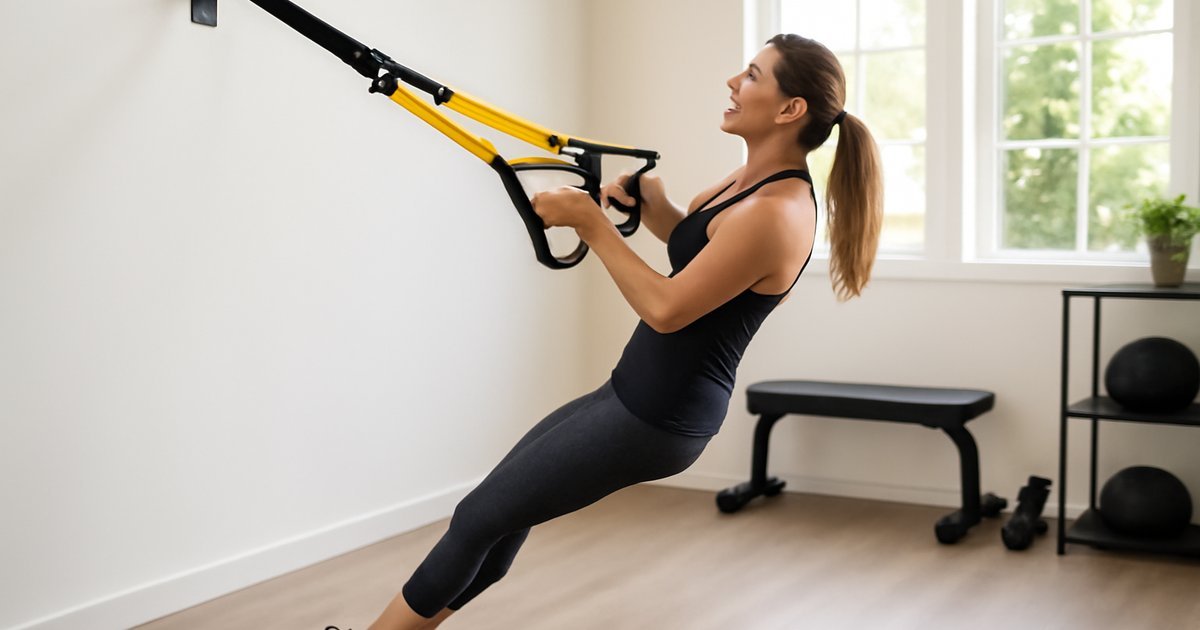
One piece of equipment. Your entire body as resistance. Science-backed results for adults at every fitness level.
Introduction
Mark, 52, spent years avoiding the gym because every machine felt foreign and intimidating. Then his physical therapist handed him two nylon straps anchored to a door frame and told him to start there. Six months later, his back pain had decreased, his posture had improved, and he was stronger than he had been in his thirties.
Mark’s experience is far from unique. According to the CDC, only about 24 percent of American adults meet the recommended guidelines for both aerobic and muscle-strengthening activity. For many people aged 30 to 70, the barrier isn’t motivation — it’s finding the right entry point.
TRX suspension training offers exactly that. Using adjustable straps anchored to a fixed point, this system lets you use your own body weight as resistance, scaling every exercise instantly by adjusting your angle. In this guide, you’ll learn what TRX training is, what the research says about its benefits, how to get started safely, and what to expect as you progress.
What Is TRX Suspension Training?
TRX — which stands for Total Body Resistance Exercise — is a form of suspension training that uses two adjustable nylon straps with handles and foot cradles. One end anchors to a stable overhead structure such as a door, beam, or wall mount. You then use your own body weight and gravity as resistance by adjusting the angle at which you hold or support yourself.
Originally developed by US Navy SEAL Randy Hetrick in the late 1990s as a portable fitness solution for military deployment, TRX was later commercialized and has since become a staple in physical therapy clinics, hospital wellness programs, and mainstream gyms across the country.
The key feature that distinguishes suspension training from conventional resistance training is instability. Because the straps move freely, your stabilizing muscles — the smaller, deeper muscles that support your joints and spine — must engage continuously throughout each movement. This makes suspension training particularly effective for building functional strength, improving balance, and reducing injury risk.
According to the American Council on Exercise (ACE), TRX training activates core musculature at significantly higher rates than many traditional mat-based exercises, even during movements that don’t appear to target the core directly.
Health Benefits Backed by Evidence
TRX suspension training is not a fitness trend. A growing body of peer-reviewed research supports its use across a wide range of health and fitness goals, particularly for adults in their middle and later years.
Full-Body Strength Without Heavy Loads
One of the most clinically significant advantages of suspension training is that it builds meaningful muscle strength without requiring heavy external weights. This is especially important for adults over 40, who may have joint sensitivities, osteoporosis concerns, or orthopedic contraindications that make traditional barbell or machine training risky.
A 2017 study published in the Journal of Human Kinetics found that eight weeks of TRX training produced significant improvements in muscular strength and endurance in sedentary adults, comparable to traditional resistance training protocols.
Core Stability and Spinal Health
The NIH classifies lower back pain as one of the leading causes of disability in the United States, affecting roughly 80 percent of Americans at some point in their lives. Suspension training’s inherent demand for spinal stabilization makes it a clinically useful tool for prevention and rehabilitation.
Research suggests that TRX exercises activate the transverse abdominis and multifidus — two deep spinal stabilizer muscles — more effectively than many conventional core exercises. Physical therapists and orthopedic specialists at institutions such as the Cleveland Clinic have incorporated TRX-based movements into rehabilitation programs for lumbar spine conditions.
Cardiovascular Conditioning
When performed in circuit format with minimal rest between exercises, TRX training can elevate heart rate into cardio training zones. A study from the University of Wisconsin found that a 60-minute TRX suspension training class elevated participants’ average heart rate to approximately 73 percent of maximum — well within the American Heart Association’s recommended aerobic training range.
Balance and Fall Prevention
The CDC reports that falls are the leading cause of injury-related death among adults 65 and older. Suspension training, because it continuously challenges proprioception (your body’s sense of position) and single-leg stability, is a clinically supported strategy for fall prevention. Clinical evidence indicates that TRX-based balance work improves postural control in older adults after just six to eight weeks of consistent training.
Flexibility and Mobility
Many TRX exercises incorporate active stretching through a full range of motion — the TRX Hamstring Stretch, TRX Hip Hinge, and TRX Squat all promote joint mobility while simultaneously building strength. This dual effect makes suspension training particularly efficient for time-pressed adults who want to address both flexibility and strength in a single session.
Who Is TRX Training For?
One of TRX’s most underappreciated advantages is its scalability. A complete beginner and a seasoned athlete can perform the exact same exercise — one standing more upright (less resistance) and one at a sharper angle (more resistance). This makes it appropriate for a remarkably broad population.
- Adults returning to exercise after a long break — The low-impact nature reduces injury risk during reconditioning.
- Adults with joint issues or mild arthritis — Body-weight loading is more forgiving than external weights.
- Adults recovering from injury — With physician or physical therapist clearance, TRX is widely used in post-surgical and orthopedic rehab.
- Active adults seeking variety — TRX complements existing gym routines and outdoor fitness activities.
- Travelers and those with limited space — The entire system weighs under two pounds and fits in a carry-on bag.
This varies from person to person. If you have a diagnosed musculoskeletal condition, cardiovascular disease, or balance disorder, consult your physician before starting any new exercise program, including suspension training.
Getting Started: Equipment and Setup
What You Need
The basic TRX Suspension Trainer retails between $150 and $200 and includes the straps, an anchor system, a door anchor, and an app with guided workouts. More affordable third-party suspension trainers are available, though quality and safety ratings vary. Look for systems rated to hold at least 350 pounds of dynamic load.
Safe Anchoring
Anchor safety is non-negotiable. Use a solid structural beam, a properly rated door anchor, or a wall-mounted anchor point. Never anchor to a hollow door, curtain rod, or furniture. Most TRX injuries are not caused by the exercise itself but by anchor failure.
Adjusting Length and Difficulty
Every TRX exercise can be made easier or harder by changing your body angle:
- More upright position = less body weight on the straps = easier
- More horizontal position = more body weight on the straps = harder
- Single-leg stance = increased instability challenge
This means you should never feel locked into a difficulty level that is unsafe. Progress gradually as your strength and confidence improve.
Beginner TRX Workout Routine
The following routine is appropriate for most healthy adults beginning TRX training. Perform 2-3 times per week with at least one rest day between sessions. Aim for 2 to 3 sets of 10 to 15 repetitions of each exercise, or 30 to 45 seconds of sustained effort.
- TRX Squat — Holding handles at chest height, lower into a squat. The straps assist you up, reducing knee strain. Targets quads, glutes, and core.
- TRX Row — Lean back with arms extended, then pull your chest to your hands. Targets upper back, biceps, and rear shoulders. Excellent posture correction exercise.
- TRX Push-Up — Feet in cradles or hands in handles. A TRX push-up engages significantly more core than a floor push-up.
- TRX Lunge — One foot in the cradle behind you, lower into a split squat. Builds single-leg strength and hip stability.
- TRX Plank — Feet in cradles, hold a forearm or extended plank position. The instability dramatically increases core demand.
- TRX Hip Hinge — Standing hinge at the hips with strap support, excellent for lower back health and hamstring strengthening.
- TRX Hamstring Curl — Lying on your back, heels in cradles, lift hips and curl heels toward glutes. Targets posterior chain.
As you progress, you can incorporate intermediate moves such as the TRX Pistol Squat, TRX Atomic Push-Up, TRX Pike, and TRX Power Pull. These movements demand greater strength, stability, and coordination and should be introduced gradually. If you are new to exercise altogether, consider reading our guide on building a consistent gym routine for foundational principles before adding suspension work.
TRX Training and Specific Health Conditions
Hypertension
The American Heart Association recommends muscle-strengthening activities at least two days per week as part of a comprehensive cardiovascular health plan. TRX training qualifies and, when performed at moderate intensity, is generally well-tolerated by adults with controlled hypertension. Research suggests that resistance training can help lower resting blood pressure over time. Always consult your cardiologist or primary care physician before starting a new resistance program if you have diagnosed high blood pressure.
Type 2 Diabetes
Muscle tissue is a primary site of glucose uptake. Building and maintaining lean muscle mass through resistance exercise such as TRX training is clinically associated with improved insulin sensitivity. The American Diabetes Association specifically endorses resistance training as part of the standard of care for type 2 diabetes management. Monitor blood glucose levels before and after new exercise sessions, and carry a fast-acting carbohydrate source.
Osteoporosis and Bone Density
While high-impact activities like jumping are more directly osteogenic (bone-building), resistance training does exert mechanical stress on bone tissue that research suggests supports bone mineral density maintenance. For adults with diagnosed osteoporosis, TRX’s controllable loading makes it a safer alternative to heavy barbell training, though you should work with your physician to confirm appropriate exercise selection. You can also explore our guide on bone-loading exercise options for adults for complementary strategies.
Common Mistakes to Avoid
- Skipping the warm-up — Always spend five to ten minutes mobilizing your joints before using suspension straps.
- Locking your elbows or knees — Keep a slight bend in all joints to protect cartilage and connective tissue.
- Letting the straps go slack mid-movement — Maintain consistent tension to protect your shoulders and elbows.
- Progressing too quickly — Instability training places unique demands on stabilizer muscles. Give them time to adapt before increasing difficulty.
- Ignoring pain signals — Discomfort from muscle fatigue is normal; sharp, joint-localized pain is not. Stop and assess.
For adults who want to complement their TRX work with additional strength tools, dumbbell training pairs exceptionally well with suspension training for a comprehensive home gym setup.
When to Call Your Doctor or Seek Immediate Care
Most healthy adults can begin a supervised TRX program without special medical clearance. However, you should speak with your physician before starting if you have:
- Uncontrolled hypertension (blood pressure consistently above 180/120)
- Recent heart attack, stroke, or cardiac procedure within the past six months
- Diagnosed rotator cuff tear, severe spinal stenosis, or active herniated disc
- Balance disorders, severe vertigo, or a history of multiple falls
- Pregnancy or recent childbirth (postpartum clearance required)
Seek emergency care immediately if during or after exercise you experience:
- Chest pain, pressure, or tightness
- Sudden severe shortness of breath disproportionate to exertion
- Dizziness, loss of consciousness, or near-fainting
- Sudden weakness or numbness in an arm or leg
- Severe, sudden-onset joint pain
Frequently Asked Questions
Is TRX training safe for older adults?
Yes, when properly supervised and appropriately scaled. Clinical evidence from rehabilitation settings indicates that suspension training is safe and effective for adults well into their 60s and 70s, particularly for balance improvement and functional strength. The adjustable resistance makes it safer than fixed-load equipment for beginners. Always obtain physician clearance if you have significant health conditions.
How quickly will I see results from TRX training?
Most research suggests that noticeable improvements in strength, endurance, and body composition can appear within four to eight weeks of consistent training two to three times per week. This varies from person to person depending on baseline fitness, nutrition, sleep, and other lifestyle factors. Early improvements in core stability and balance may be felt even sooner.
Can I use TRX training to lose weight?
TRX training contributes to weight management by building lean muscle mass (which increases resting metabolic rate) and burning calories during sessions. Research suggests that circuit-based TRX workouts can burn 400 to 600 calories per hour. However, clinical evidence consistently shows that exercise alone is insufficient for significant fat loss without addressing nutrition. TRX works best as part of a comprehensive lifestyle approach.
Do I need a gym to use TRX?
No. The TRX system is designed for home, office, travel, and outdoor use. A door anchor allows indoor use anywhere with a standard door. Outdoor trees, monkey bars, and jungle gyms can also serve as anchor points. This portability is one of the system’s most practical advantages for busy adults.
Is TRX better than traditional weightlifting?
Neither is universally superior. Research suggests both approaches produce meaningful strength gains. TRX offers advantages in core activation, portability, joint-friendliness, and scalability. Traditional weightlifting offers advantages in progressive overload precision and maximum strength development. Most clinical exercise specialists recommend combining both modalities for well-rounded fitness outcomes.
Conclusion
TRX suspension training is one of the most accessible, evidence-supported, and adaptable fitness tools available to adults in their 30s through their 70s. Whether your goal is improving core strength, managing a chronic condition, recovering from injury, or simply building a consistent exercise habit that fits your real life, suspension training meets you where you are.
The research is clear: consistent resistance training is one of the most powerful things you can do for long-term health, and TRX delivers that benefit with a degree of flexibility that few systems can match. Start with the basics, progress deliberately, and work alongside your healthcare provider to build a plan that supports your specific health goals. Your body — and your future self — will thank you.
Medical Disclaimer: This article is for informational and educational purposes only. It does not constitute medical advice, diagnosis, or treatment. Always consult your physician or a qualified healthcare provider before making changes to your health routine or treatment plan.
Medically reviewed by our editorial health team. Content follows evidence-based standards aligned with CDC and NIH guidelines.