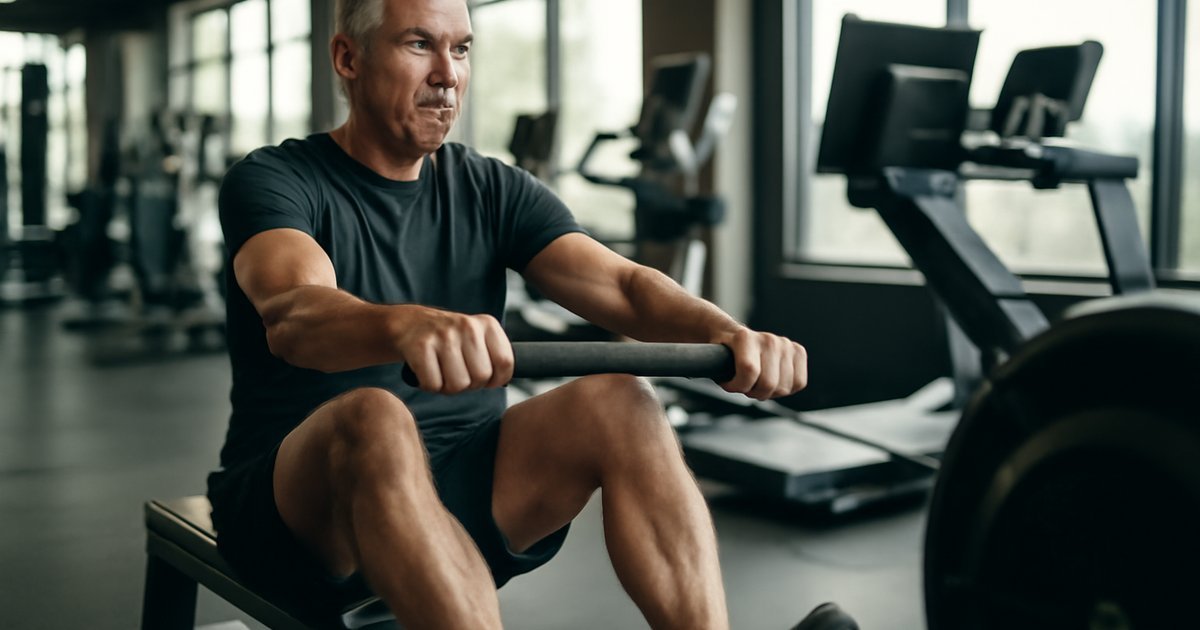
Rowing Machine Workouts: Full-Body Fitness for Adults
One machine, one fluid motion — and nearly every major muscle group engaged at once.
Mark, 54, had been living with mild knee pain for years. Running was off the table. Cycling helped but left his upper body untrained. Then his physical therapist suggested the rowing machine — and within three months, he had lost 14 pounds, improved his resting heart rate, and felt stronger than he had in his forties.
Stories like Mark’s are increasingly common. According to the American College of Sports Medicine, rowing consistently ranks among the top-recommended low-impact cardio exercises for adults managing joint issues, cardiovascular risk, or the natural strength loss that comes with aging. Yet surveys suggest that fewer than 15% of gym-goers regularly use the rowing machine — largely because many adults feel unsure how to use it correctly or don’t realize what it can do for their health.
This guide breaks down everything you need to know about rowing machine workouts: the health benefits, proper technique, sample workout plans, safety considerations, and how to get started — whether you’re a complete beginner or returning to fitness after a break.
What Is Rowing Machine Exercise?
A rowing machine — also called an ergometer or "erg" — is a piece of exercise equipment that simulates the motion of rowing a boat. You sit on a sliding seat, secure your feet in footrests, grip a handle attached to a flywheel or water tank via a chain or strap, and perform a coordinated push-pull motion that moves your entire body.
Unlike treadmills or ellipticals, which are primarily lower-body machines, the rowing stroke engages approximately 86% of the body’s muscles, according to research published in the Journal of Strength and Conditioning Research. This includes the quadriceps, hamstrings, glutes, core, back, shoulders, and biceps — all in a single, rhythmic movement.
There are four main types of rowing machines available today:
- Air resistance (fan-based): Resistance increases with your stroke intensity. Used widely in gyms and by competitive rowers.
- Water resistance: Uses a water-filled tank for a realistic rowing feel and smooth glide.
- Magnetic resistance: Quieter, with adjustable resistance levels — often preferred for home use.
- Hydraulic piston: Compact and affordable, ideal for small spaces but less dynamic than other types.
In the US, both commercial gyms and home fitness markets have seen significant growth in rowing equipment. The National Sporting Goods Association reported that rowing machine usage increased by over 40% between 2019 and 2023, a trend that has continued into the mid-2020s.
Health Benefits of Rowing Machine Workouts
Clinical evidence suggests that rowing offers a unique combination of cardiovascular conditioning, muscular strength development, and metabolic benefits that few other single exercises can match.
Cardiovascular Health
Regular aerobic exercise is one of the most well-established interventions for cardiovascular disease prevention. The American Heart Association recommends at least 150 minutes of moderate-intensity aerobic activity per week for adults. Rowing efficiently fills that prescription.
A 2022 study published in the European Journal of Preventive Cardiology found that consistent rowing exercise significantly improved VO2 max — a key measure of cardiovascular fitness — in adults aged 40 to 65 over a 12-week period. Improved VO2 max is associated with reduced risk of heart disease, stroke, and all-cause mortality.
Full-Body Muscle Engagement
Unlike running or cycling, rowing actively recruits both upper and lower body muscle groups. Research suggests that a properly executed rowing stroke is roughly 60% leg drive and 40% upper body pull — making it one of the most complete full-body workouts available on a single machine.
This is particularly valuable for adults over 40, who naturally lose 3-8% of muscle mass per decade (a process called sarcopenia) without resistance-based activity. Rowing offers a way to counteract that loss while also improving cardiovascular health at the same time. If you are also interested in building muscle strength directly, our guide on Strength Training for Adults: Benefits, How to Start & Tips provides complementary strategies.
Low-Impact Joint Stress
One of rowing’s most clinically relevant advantages is its low-impact nature. Unlike running, which generates ground reaction forces of two to three times body weight with each stride, rowing involves no impact loading on the joints. The hips, knees, and ankles are loaded through smooth, controlled compression — not shock.
This makes rowing particularly suitable for adults with mild osteoarthritis, previous joint injuries, or those who have been advised to avoid high-impact activity. The Mayo Clinic includes rowing among its recommended low-impact cardio options for older adults and individuals managing joint conditions.
Caloric Burn and Metabolic Effect
According to Harvard Health Publishing, a 155-pound adult can burn approximately 260 calories in 30 minutes of moderate-intensity rowing — comparable to cycling and swimming. At vigorous intensity, that figure climbs to roughly 316 calories per 30 minutes. Combined with rowing’s muscle-building effects, which elevate resting metabolic rate, this makes it a meaningful tool for weight management.
Mental Health and Stress Reduction
Exercise’s role in reducing anxiety and depression symptoms is well-documented. The rhythmic, meditative quality of rowing — coordinated breathing, repetitive motion — has been associated in clinical observation with improvements in stress levels and mood. A 2021 review in Frontiers in Psychology found that rhythmic, cyclical exercises like rowing can activate parasympathetic nervous system responses, supporting stress recovery.
Understanding Proper Rowing Technique
Correct form is essential for rowing. Poor technique is the primary cause of back and shoulder injuries associated with this exercise. Before increasing intensity or duration, focus on mastering the four phases of the rowing stroke.
The Four Phases of the Rowing Stroke
- The Catch: Start position. Arms extended, shins vertical, back tall and slightly leaned forward. Core engaged. This is where the stroke begins.
- The Drive: Push through your feet first — legs extend before the back leans back and arms pull. This sequence (legs → back → arms) is critical. Reversing this order causes back strain.
- The Finish: Legs flat, back leaned slightly back (about 11 o’clock position), elbows drawn past the ribs, handle at the lower chest.
- The Recovery: The reverse sequence — arms extend first, then body leans forward, then knees bend to slide back to the catch. Movements should be controlled and smooth.
A common coaching cue is: "Legs, body, arms — arms, body, legs." If you remember only one thing about rowing form, remember that sequence.
Common mistakes to avoid:
- Rounding the lower back during the drive
- Pulling with the arms before the legs fully extend
- Leaning back excessively past 1 o’clock position
- Rushing the recovery (recovery should be slower than the drive)
- Gripping the handle too tightly — use a loose, relaxed grip
If possible, schedule one session with a certified personal trainer or watch technique guidance from a certified rowing coach before training on your own. Many gyms offer brief equipment orientations at no charge.
Rowing Workouts for Adults: Beginner to Intermediate
These sample workouts are designed around the most common fitness goals for adults aged 30 to 70. Always warm up for 3-5 minutes at a slow, easy pace before beginning and cool down with light movement and stretching afterward.
Beginner Workout (Weeks 1-4)
Goal: Build technique and aerobic base
Frequency: 3 days per week, with at least one rest day between sessions
- Row at an easy, conversational pace for 5 minutes
- Rest 2 minutes (slow walk or light stretching)
- Row for another 5 minutes
- Total rowing time: 10-15 minutes per session
Focus entirely on form during this phase. Keep your stroke rate (strokes per minute, shown on the monitor as "SPM") between 18 and 22 — slower strokes allow more time to think through technique.
Steady-State Cardio Workout (Weeks 4-8)
Goal: Cardiovascular endurance
Frequency: 3-4 days per week
- Warm up: 3 minutes easy rowing
- Row at moderate, steady intensity for 20-30 minutes (SPM: 22-26)
- Cool down: 3 minutes easy rowing + stretching
At this intensity, you should be able to speak in short sentences but feel moderately challenged. This is approximately 60-70% of your maximum heart rate.
Interval Workout (Intermediate, Weeks 6+)
Goal: Boost cardiovascular fitness and caloric burn
Frequency: 2 days per week, alternating with steady-state sessions
- Warm up: 5 minutes easy
- Row hard for 1 minute (high effort, SPM 26-30)
- Row easy for 2 minutes (recovery)
- Repeat 6-8 times
- Cool down: 5 minutes easy + stretching
This format is similar to interval walking or HIIT principles — short bursts of high effort followed by active recovery. Research consistently shows interval-based training produces significant cardiovascular gains in shorter time periods compared to steady-state cardio alone. For a complementary approach to interval training, see our article on Interval Walking: The Smart Way to Walk for Better Health.
Weekly Sample Schedule
- Monday: Steady-state rowing, 25 minutes
- Tuesday: Rest or light stretching
- Wednesday: Interval rowing session
- Thursday: Rest or complementary strength training
- Friday: Steady-state rowing, 30 minutes
- Saturday: Active recovery (walking, yoga)
- Sunday: Full rest
Rowing for Specific Health Goals
Rowing for Weight Management
Rowing combines aerobic caloric expenditure with muscle-building effects, creating a dual metabolic advantage. Clinical evidence indicates that combining resistance and aerobic exercise in one session — as rowing does naturally — produces greater improvements in body composition than either modality alone. The CDC recommends a combination of aerobic activity and muscle-strengthening exercises for adults; rowing addresses both simultaneously.
Rowing for Back Strength and Posture
When performed with correct form, rowing actively strengthens the erector spinae, rhomboids, and lats — muscles critical to upright posture and spinal health. Many physical therapists recommend rowing as a rehabilitation and strengthening tool for adults with mild, non-acute lower back concerns. However, rowing should be avoided or carefully modified for anyone with acute back injuries, herniated discs, or conditions affecting spinal stability. Always consult your physician before beginning.
Rowing for Older Adults (55+)
For adults in the 55-70 age group, rowing offers an exceptional combination of functional fitness benefits: cardiovascular conditioning, balance support through core engagement, and upper and lower body strength — all without the fall risk of outdoor activities or the joint stress of running. The NIH National Institute on Aging emphasizes multi-component exercise programs for older adults, and rowing fulfills multiple components in a single session.
Older adults should begin at lower intensities and shorter durations, and may benefit from working with a physical therapist or certified trainer experienced in senior fitness when starting out. If you are looking to complement rowing with additional strength building, our guide on Circuit Training for Adults: Benefits, Workouts & How to Start offers a practical multi-exercise framework.
Safety Considerations and Who Should Use Caution
Rowing is safe for most adults when technique is sound and intensity is appropriate. However, certain individuals should take additional precautions or consult their physician before starting.
Use caution or get medical clearance if you have:
- Acute lower back pain, herniated discs, or recent spinal surgery
- Uncontrolled cardiovascular conditions
- Recent knee, hip, or shoulder surgery or injury
- Osteoporosis with significant spinal involvement
- Any condition requiring exercise restriction from your physician
This varies from person to person, and even within these categories, many individuals can row safely with appropriate modifications — but the conversation with your healthcare provider is essential first.
When to Call Your Doctor or Seek Emergency Care
Stop rowing immediately and seek emergency medical attention if you experience:
- Chest pain, pressure, or tightness during or after exercise
- Shortness of breath disproportionate to effort level
- Sudden dizziness, fainting, or loss of coordination
- Heart palpitations (irregular, racing, or fluttering heartbeat)
- Sudden severe pain in the back, joints, or muscles
Contact your doctor at your next available appointment if you experience:
- Persistent soreness in the lower back lasting more than 48-72 hours after rowing
- Joint swelling or increased pain in the knees or hips following sessions
- Unusual fatigue that doesn’t resolve with rest
- Any new symptoms that coincide with starting your rowing program
The American Heart Association recommends that adults over 40 who are starting a new vigorous exercise program speak with their physician beforehand — particularly if they have risk factors for cardiovascular disease, diabetes, or high blood pressure.
Frequently Asked Questions
How long should I row as a beginner?
Most physicians and fitness professionals recommend starting with 10-15 minutes per session, three times per week, focusing on technique rather than intensity or duration. As your fitness improves over four to six weeks, you can gradually extend sessions to 20-30 minutes. The most important principle early on is consistency over intensity.
Is rowing safe if I have knee problems?
For many people with mild knee osteoarthritis or previous knee injuries, rowing is well-tolerated because it avoids impact loading. However, the knee does flex under load during the catch phase, which can be uncomfortable for some individuals. Clinical evidence suggests that adjusting the foot stretcher to a lower setting (reducing knee flexion angle) and shortening the stroke slightly can reduce discomfort. Always consult your orthopedic physician or physical therapist before rowing with a knee condition.
Can rowing help me lose belly fat?
Research suggests that consistent aerobic exercise, including rowing, contributes to overall body fat reduction — including visceral (abdominal) fat — especially when combined with a balanced diet. However, you cannot target fat loss in one specific area through exercise alone. A sustained program of regular rowing, combined with appropriate nutrition, supports healthy weight management over time.
How many calories does 20 minutes of rowing burn?
Caloric expenditure varies based on body weight, intensity, and individual metabolism. According to Harvard Health Publishing estimates, a 155-pound adult burns approximately 175-200 calories in 20 minutes of moderate rowing. At vigorous effort, that figure may reach 210-250 calories. These numbers are general estimates — actual results vary from person to person.
Is it okay to row every day?
Most fitness and sports medicine professionals recommend against intense rowing every day, particularly for beginners. Your muscles, connective tissue, and cardiovascular system need recovery time to adapt and strengthen. Three to five sessions per week with at least one full rest day is a widely supported framework. Active recovery days — light walking, stretching, or yoga — are generally encouraged on non-rowing days.
Conclusion
Rowing machine workouts offer one of the most complete fitness solutions available to adults across a wide age range. The combination of cardiovascular conditioning, full-body muscular engagement, and low-impact joint loading makes it particularly well-suited for adults over 40 managing the physical realities of aging — from joint sensitivity to muscle loss to cardiovascular risk.
Like any exercise program, results depend on consistency, appropriate progression, and safe technique. Start conservatively, prioritize form over intensity, and build gradually. Within weeks, most adults notice meaningful improvements in energy, strength, and endurance.
Your health journey is uniquely yours. Rowing may be an excellent fit — but the best next step is always a conversation with your healthcare provider to make sure it aligns with your individual health status and goals.
Medical Disclaimer: This article is for informational and educational purposes only. It does not constitute medical advice, diagnosis, or treatment. Always consult your physician or a qualified healthcare provider before making changes to your health routine or treatment plan.
Medically reviewed by our editorial health team. Content follows evidence-based standards aligned with CDC and NIH guidelines.