Aqua Jogging for Adults: Benefits, Technique & How to Start
Low-impact, high-reward — deep water running may be the most underrated cardio workout for adults over 30.
Introduction
Mark, 52, had been an avid runner for nearly two decades when a stress fracture in his foot brought everything to a halt. His orthopedist cleared him for "non-weight-bearing cardio only" — and that was when he discovered aqua jogging. Within eight weeks, he had maintained his cardiovascular fitness, avoided muscle loss, and returned to land running stronger than before.
Mark’s story is more common than you might think. According to the CDC, more than 50 million American adults report chronic joint pain, arthritis, or musculoskeletal conditions that make traditional land-based exercise difficult or impossible. Yet staying physically active remains one of the most powerful tools for managing chronic disease, controlling weight, and preserving mental health.
Aqua jogging — also called deep water running — offers a compelling solution. It mimics the biomechanics of land running while eliminating up to 90% of the impact on your joints. In this guide, you’ll learn exactly what aqua jogging is, who benefits most, how to do it correctly, and how to build a sustainable routine that delivers real fitness results.
What Is Aqua Jogging?
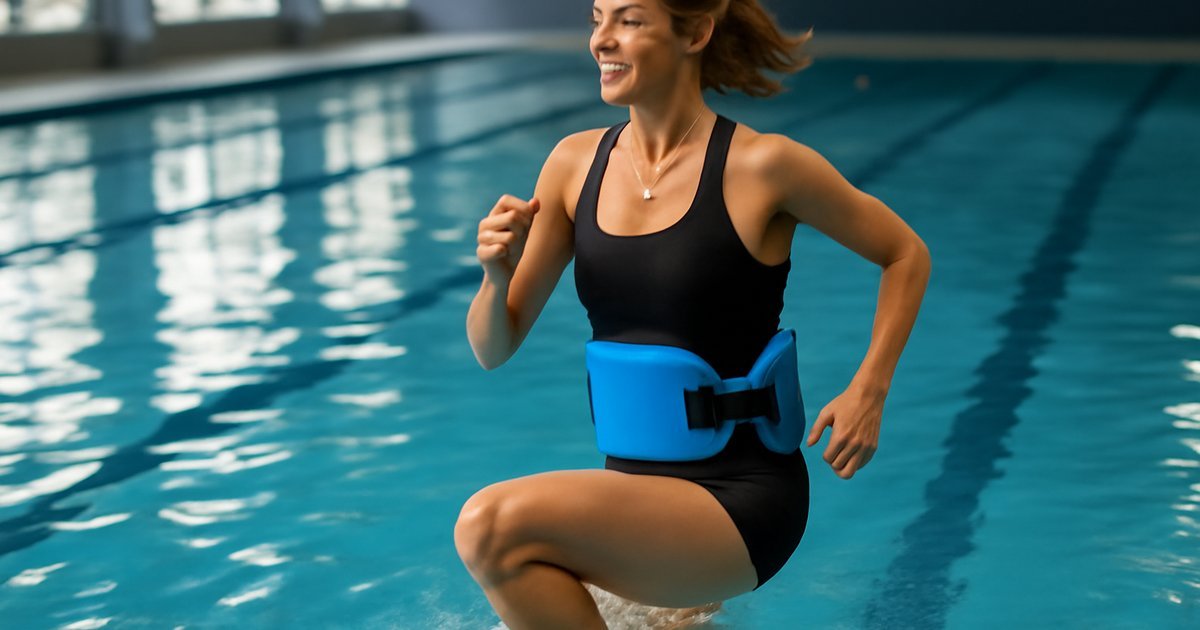
Aqua jogging is a form of cardiovascular exercise performed in the deep end of a pool, where your feet do not touch the bottom. You wear a buoyancy belt — a foam flotation device worn around your waist — that keeps your head above water while you simulate a running stride in place.
Unlike shallow-water aerobics, deep water running engages the same large muscle groups used in land running: your quadriceps, hamstrings, glutes, hip flexors, and core. Because water provides resistance in all directions — roughly 12 to 14 times greater than air — your muscles work significantly harder with each stride, even at lower perceived intensities.
The American College of Sports Medicine (ACSM) classifies deep water running as a moderate-to-vigorous aerobic activity suitable for healthy adults and those with orthopedic limitations. It has been used for decades in physical therapy settings and by elite athletes — Olympic sprinters and professional football players have long relied on it for injury rehabilitation and cross-training.
Today, aqua jogging is gaining wider recognition as a primary fitness activity — not just a backup plan — for adults seeking effective, joint-friendly cardio.
Health Benefits of Aqua Jogging
The benefits of aqua jogging extend well beyond joint protection. Clinical evidence supports its effectiveness across multiple dimensions of health and fitness.
Cardiovascular fitness: A study published in the Journal of Strength and Conditioning Research found that recreational runners who maintained their training with deep water running during an injury period preserved VO2 max — the gold standard of aerobic capacity — comparably to those who continued land training. Your heart and lungs receive a genuine cardiovascular workout.
Caloric expenditure: Research suggests that aqua jogging at moderate-to-vigorous intensity burns between 400 and 600 calories per hour, depending on body weight, effort level, and water temperature. This is comparable to land jogging for many individuals.
Muscle engagement: Water’s multidirectional resistance means every forward stride is also countered by backward resistance, creating a natural eccentric and concentric training stimulus. Your core works continuously to stabilize your upright posture in the water.
Reduced injury risk: Because aqua jogging is fully non-weight-bearing, it eliminates the repetitive ground impact forces that contribute to stress fractures, shin splints, knee pain, and hip injuries. The CDC notes that water-based exercise is among the most recommended physical activities for adults with arthritis.
Mental health benefits: Like all aerobic exercise, aqua jogging stimulates the release of endorphins and has been associated with reductions in anxiety and depression symptoms, according to NIH-cited research on exercise and mood regulation.
Thermoregulation and comfort: Exercising in cool water helps prevent overheating, making it a practical option for adults who struggle with heat intolerance due to certain medications or conditions such as multiple sclerosis.
Who Should Consider Aqua Jogging?
Aqua jogging is uniquely positioned for a broad range of adults. This varies from person to person, but clinical evidence and sports medicine practice suggest it is especially well-suited for:
- Adults recovering from orthopedic injuries — stress fractures, ACL tears, hip replacements, knee surgeries
- Individuals with osteoarthritis — especially of the knee, hip, or ankle
- Runners and cyclists dealing with overuse injuries — who want to maintain fitness without losing ground
- Adults with obesity — who find land-based running uncomfortable or high-risk for joint damage
- Pregnant women (with physician clearance) — seeking low-impact cardio that supports circulation and reduces swelling
- Older adults aged 55+ — looking for effective cardio that doesn’t stress aging joints and connective tissue
- Anyone seeking a cross-training option to complement existing exercise without adding impact volume
A 2022 review published through NIH’s PubMed database confirmed that water-based exercise programs significantly improved pain, physical function, and quality of life in adults with lower-limb musculoskeletal conditions.
Proper Aqua Jogging Technique
Technique matters more in the water than you might expect. Poor form leads to reduced cardiovascular stimulus, muscle imbalances, and frustration. Most physicians and aquatic fitness specialists recommend the following approach:
Body Position
- Stand tall — avoid leaning too far forward or backward
- Keep your shoulders relaxed and slightly above the waterline
- Engage your core throughout the session to stabilize your torso
- Your head stays above water naturally with a properly fitted buoyancy belt
Leg Movement
- Replicate your land running stride — lift your knees to roughly hip height
- Push down and back with each stride, as if pressing off the ground
- Avoid a bicycle-pedaling motion — this reduces the running-specific muscle recruitment
- Keep your foot flexed (dorsiflexed) rather than pointed
Arm Movement
- Swing your arms in opposition to your legs — left arm forward with right leg forward
- Keep elbows bent at roughly 90 degrees
- Cup your hands slightly — this increases resistance and improves balance
Cadence and Intensity
- Most experts suggest aiming for 60 to 80 strides per minute as a baseline
- Use a waterproof interval timer or pool clock to monitor your effort
- Your perceived effort in water often feels lower than your actual heart rate — clinical evidence indicates heart rates run approximately 10 to 15 beats per minute lower in water than during equivalent land exercise, a phenomenon called "heart rate lag"
- Use the Rate of Perceived Exertion (RPE) scale or a waterproof heart rate monitor to gauge intensity accurately
How to Start: A Beginner’s Aqua Jogging Plan
If you’re new to aqua jogging, start conservatively. Your cardiovascular system may adapt faster than your neuromuscular coordination in the water. Most aquatic fitness specialists recommend beginning with two to three sessions per week.
Equipment you’ll need:
- Aqua jogging belt (buoyancy belt) — available at most sporting goods stores for $25–$60
- Swimsuit or athletic swim shorts
- Optional: water shoes for traction when entering/exiting the pool, waterproof heart rate monitor
Week 1–2 (Foundation): 20–25 minutes per session at easy to moderate effort (RPE 5–6 out of 10). Focus entirely on form — body position, arm swing, and stride pattern. Rest 1–2 minutes between any intervals.
Week 3–4 (Building): Extend sessions to 30–35 minutes. Introduce simple intervals: 2 minutes at moderate effort, 1 minute at easy recovery. Repeat 6–8 times. This structure mirrors the interval walking training approach used in many cardiac rehabilitation programs.
Week 5–8 (Progression): Sessions of 40–50 minutes. Increase interval intensity — try 30-second hard efforts followed by 90 seconds of easy jogging, repeated 10–12 times. This mirrors HIIT-style training adapted for water.
Research from the American College of Sports Medicine suggests that adults need at least 150 minutes of moderate-intensity or 75 minutes of vigorous-intensity aerobic activity per week for substantial health benefits — a goal aqua jogging can fully support.
Aqua Jogging vs. Other Low-Impact Cardio Options
Many adults weighing their options wonder how aqua jogging compares to other joint-friendly forms of cardio. Here’s a brief clinical overview:
- Aqua jogging vs. swimming: Swimming requires stroke technique and breath timing that takes time to learn. Aqua jogging requires no swimming ability and more closely mimics the running movement pattern, making it more specific for runners in rehabilitation.
- Aqua jogging vs. cycling: Cycling is also low-impact, but primarily trains the lower body in a seated, limited range of motion. Aqua jogging engages the core and upper body more dynamically and keeps you in an upright position that transfers more directly to everyday movement.
- Aqua jogging vs. elliptical training: The elliptical offers a weight-bearing alternative with low impact, but still involves ground contact and vertical load. Aqua jogging is truly non-weight-bearing, making it the safer choice for stress fractures or post-surgical recovery.
For many adults, the best approach is to combine aqua jogging with complementary activities like stretching and mobility training or stationary bike workouts to create a well-rounded, low-impact fitness program.
Living With Limitations: Making Aqua Jogging Work for You
One of aqua jogging’s greatest strengths is its adaptability. If you have a specific health condition, a few practical adjustments can make the workout safer and more effective.
If you have arthritis: Warm water (between 83°F and 88°F) is preferable — it reduces joint stiffness and pain. Many community pools offer heated therapeutic pools. The Arthritis Foundation recommends water exercise as a first-line activity for adults with osteoarthritis and rheumatoid arthritis.
If you have cardiovascular disease: Get explicit clearance from your cardiologist before starting. Heart rate in water runs lower due to hydrostatic pressure and the diving reflex — your doctor may need to adjust your target heart rate zone accordingly.
If you have diabetes: Monitor blood glucose before and after sessions, as with any cardio workout. Aqua jogging can contribute meaningfully to blood sugar management — the CDC notes that regular aerobic activity improves insulin sensitivity in adults with type 2 diabetes.
If you are postpartum or pregnant: Always obtain your OB-GYN’s approval. The American College of Obstetricians and Gynecologists (ACOG) generally supports aquatic exercise as safe during uncomplicated pregnancies, though specific guidelines vary by trimester and individual risk factors.
For adults managing multiple conditions or returning from injury, aqua jogging pairs well with elliptical machine workouts as part of a phased return-to-activity plan developed with your healthcare team.
When to Call Your Doctor — and Red Flag Signs
Aqua jogging is broadly safe, but certain signs during or after exercise require prompt medical attention. Stop your session and seek care immediately if you experience:
- Chest pain, pressure, or tightness
- Severe shortness of breath disproportionate to effort
- Dizziness, lightheadedness, or fainting
- Sudden sharp pain in a joint or muscle
- Heart palpitations or an irregular heartbeat
- Sudden numbness or weakness in any limb
These are potential signs of serious cardiac, neurological, or musculoskeletal events — contact 911 or your nearest emergency room without delay.
At your next routine physician visit, bring up aqua jogging if you:
- Have not exercised regularly in more than six months
- Are managing a chronic condition such as hypertension, diabetes, or heart disease
- Are recovering from surgery or a significant injury
- Are over 60 and beginning a new exercise program for the first time
Most physicians will enthusiastically support aqua jogging — it is one of the few forms of cardio exercise that works across an exceptionally wide range of health conditions and fitness levels.
Frequently Asked Questions
Do I need to know how to swim to do aqua jogging?
No. Because a buoyancy belt keeps you afloat in the vertical position, swimming ability is not required. However, comfort in water is important for safety. If you are not comfortable in deep water, practice in the shallow end first and always exercise near a lifeguard.
Can aqua jogging replace land running for fitness?
Research suggests it can maintain cardiovascular fitness very effectively — multiple studies support near-equivalent VO2 max preservation during short-to-medium injury recovery periods. For long-term fitness goals, most sports medicine physicians recommend returning to land running when cleared, using aqua jogging as a complement or cross-training tool.
How long before I see fitness results from aqua jogging?
Most adults report noticeable improvements in cardiovascular endurance and reduced fatigue within four to six weeks of consistent training at two to three sessions per week. This varies from person to person depending on baseline fitness, age, and effort level.
Is aqua jogging good for weight loss?
Clinical evidence indicates that aqua jogging can contribute meaningfully to caloric expenditure and support weight management when combined with a balanced diet. It is particularly effective for adults who cannot sustain higher-impact exercise due to joint pain or obesity.
Where can I find a pool for aqua jogging?
Community recreation centers, YMCAs, hospital wellness facilities, and university athletic centers typically offer lap pools available during open swim hours. Many also offer organized aqua fitness classes that include deep water running components. Call ahead to confirm pool depth — you need at least five to six feet of water for true non-weight-bearing aqua jogging.
Conclusion
Aqua jogging is far more than a rehabilitation workaround. For adults navigating joint pain, injury recovery, chronic conditions, or simply a desire for smarter training, deep water running delivers genuine cardiovascular, muscular, and mental health benefits — with a fraction of the physical cost of land-based impact exercise.
The science is clear and the barrier to entry is low: a buoyancy belt, access to a pool, and a willingness to try something different are all you need to get started. Whether you’re a sidelined runner like Mark or a health-conscious adult looking for a sustainable long-term fitness strategy, aqua jogging deserves a serious place in your weekly routine.
As always, talk to your physician before beginning any new exercise program — especially if you are managing a chronic condition or recovering from an injury. Your doctor can help you tailor intensity, frequency, and duration to your specific health needs.
Medical Disclaimer: This article is for informational and educational purposes only. It does not constitute medical advice, diagnosis, or treatment. Always consult your physician or a qualified healthcare provider before making changes to your health routine or treatment plan.
Medically reviewed by our editorial health team. Content follows evidence-based standards aligned with CDC and NIH guidelines.