HIIT Workouts for Adults Over 40: The Complete Guide
High-intensity interval training isn’t just for elite athletes — done correctly, it may be one of the most time-efficient ways to protect your heart, metabolism, and muscle mass as you age.
Mark, 47, had been walking on the treadmill for 45 minutes every morning for two years. His weight hadn’t budged, his energy was still sluggish, and his last checkup showed his fasting blood sugar was creeping upward. His doctor suggested he try something different: high-intensity interval training. Within 12 weeks, Mark had dropped 11 pounds, improved his blood sugar markers, and was finishing his workouts in under 25 minutes.
According to the American College of Sports Medicine, HIIT — which alternates short bursts of intense effort with recovery periods — has become one of the most researched and recommended fitness strategies for adults managing weight, cardiovascular risk, and metabolic health. Yet many people over 40 assume it’s too advanced, too risky, or simply not for them.
This guide will show you exactly what HIIT is, how it differs from traditional exercise, what the clinical evidence says about its benefits and safety for adults aged 40 and older, and how to start a program that fits your current fitness level without putting your joints or heart at unnecessary risk.
What Is HIIT and How Does It Work?
High-intensity interval training, or HIIT, is a structured exercise method that alternates between short periods of vigorous physical effort — typically 80 to 95 percent of your maximum heart rate — and periods of low-intensity movement or complete rest. A single session generally lasts between 15 and 30 minutes.
The core principle behind HIIT is something exercise physiologists call the excess post-exercise oxygen consumption effect, often abbreviated as EPOC. After a HIIT session, your body continues to burn calories at an elevated rate for hours as it works to restore oxygen levels, repair muscle tissue, and return to its resting state. This is sometimes referred to informally as the "afterburn effect."
According to a landmark review published in the British Journal of Sports Medicine, HIIT can produce comparable or superior improvements in cardiorespiratory fitness compared to moderate-intensity continuous training, even when total exercise time is significantly shorter. That makes it particularly valuable for adults over 40 who struggle to carve out long exercise windows in a busy schedule.
HIIT is not a single fixed workout. It can be performed using bodyweight exercises, cycling, swimming, rowing, elliptical training, or brisk walking intervals — making it adaptable to nearly every fitness level, joint concern, and personal preference.
Benefits of HIIT for Adults Over 40
The physiological changes that begin in your 40s — declining muscle mass, slowing metabolism, reduced insulin sensitivity, and subtle drops in cardiovascular efficiency — are precisely the areas where clinical evidence suggests HIIT can offer meaningful support.
Metabolic health: A 2022 meta-analysis published in Obesity Reviews found that HIIT was associated with significant reductions in visceral fat — the deep abdominal fat linked to type 2 diabetes, heart disease, and metabolic syndrome — compared to moderate-intensity exercise over the same time period. For adults whose metabolism has begun to slow, this distinction matters.
Cardiovascular protection: The American Heart Association recognizes vigorous-intensity aerobic activity as a cornerstone of heart disease prevention. Research suggests that HIIT improves VO2 max — your body’s maximum capacity to use oxygen during exercise — which is one of the strongest predictors of long-term cardiovascular health and overall longevity.
Blood sugar regulation: The CDC reports that more than one-third of American adults have prediabetes, and the majority are over 45. Clinical evidence indicates that HIIT improves insulin sensitivity — how effectively your cells respond to insulin — more rapidly than steady-state cardio, potentially helping to slow or prevent the progression toward type 2 diabetes.
Muscle preservation: After age 40, adults lose roughly 3 to 8 percent of muscle mass per decade — a process called sarcopenia. Unlike traditional cardio, resistance-based HIIT workouts can stimulate muscle protein synthesis, helping to slow this age-related muscle loss. For more on preserving strength as you age, see our guide on Strength Training After 50: The Complete Guide.
Mental health and cognition: Research from Johns Hopkins Medicine suggests that vigorous aerobic exercise promotes the release of brain-derived neurotrophic factor (BDNF), a protein that supports memory, learning, and mood regulation — benefits that become increasingly relevant as adults move through their 40s, 50s, and 60s.
Is HIIT Safe After 40? Risks and Precautions
Safety is the first question most adults over 40 — and their physicians — ask about HIIT. The honest answer is: it depends on where you’re starting from, and how you approach it.
For most healthy adults without significant cardiovascular disease, orthopedic injuries, or uncontrolled chronic conditions, HIIT is considered safe when introduced gradually. A 2023 systematic review in the Journal of the American Heart Association found no significantly higher rate of adverse cardiac events in HIIT participants compared to moderate-intensity exercise groups — a finding that has reassured many cardiologists who previously hesitated to recommend it.
That said, individual variation is real and significant. Before starting a HIIT program, most physicians recommend:
- A baseline cardiovascular evaluation if you’ve been sedentary for more than six months
- A discussion with your doctor if you have hypertension, coronary artery disease, atrial fibrillation, or Type 2 diabetes
- An honest assessment of any joint issues — knees, hips, lower back — that may require exercise modifications
- Starting with low-impact HIIT formats (cycling, swimming, elliptical) before progressing to higher-impact movements
The most common injuries associated with HIIT in adults over 40 are not cardiac — they are musculoskeletal: pulled muscles, tendon irritation, and knee pain caused by doing too much too soon. Proper warm-up is non-negotiable. Pairing HIIT with dedicated flexibility work can also significantly reduce injury risk — our article on Flexibility Training: The Complete Guide for Adults covers exactly how to do this.
How to Start a HIIT Program: A Practical Framework
One of the most common mistakes adults make when beginning HIIT is starting at an intensity designed for 25-year-old athletes. The clinical evidence does not suggest you need to push to your absolute limit to gain the metabolic and cardiovascular benefits. Research from the Mayo Clinic indicates that even moderate-to-vigorous interval training — reaching roughly 75 to 85 percent of your maximum heart rate — produces meaningful health improvements in deconditioned adults.
Here is a beginner-friendly framework that most exercise physiologists recommend for adults over 40 who are new to interval training:
Phase 1 — Weeks 1-2 (Foundation): 20 minutes, twice per week. Alternate 30 seconds of brisk walking or light cycling at a pace that makes conversation difficult, followed by 90 seconds of slow recovery walking. Repeat 8 times. Focus on breathing and form, not speed.
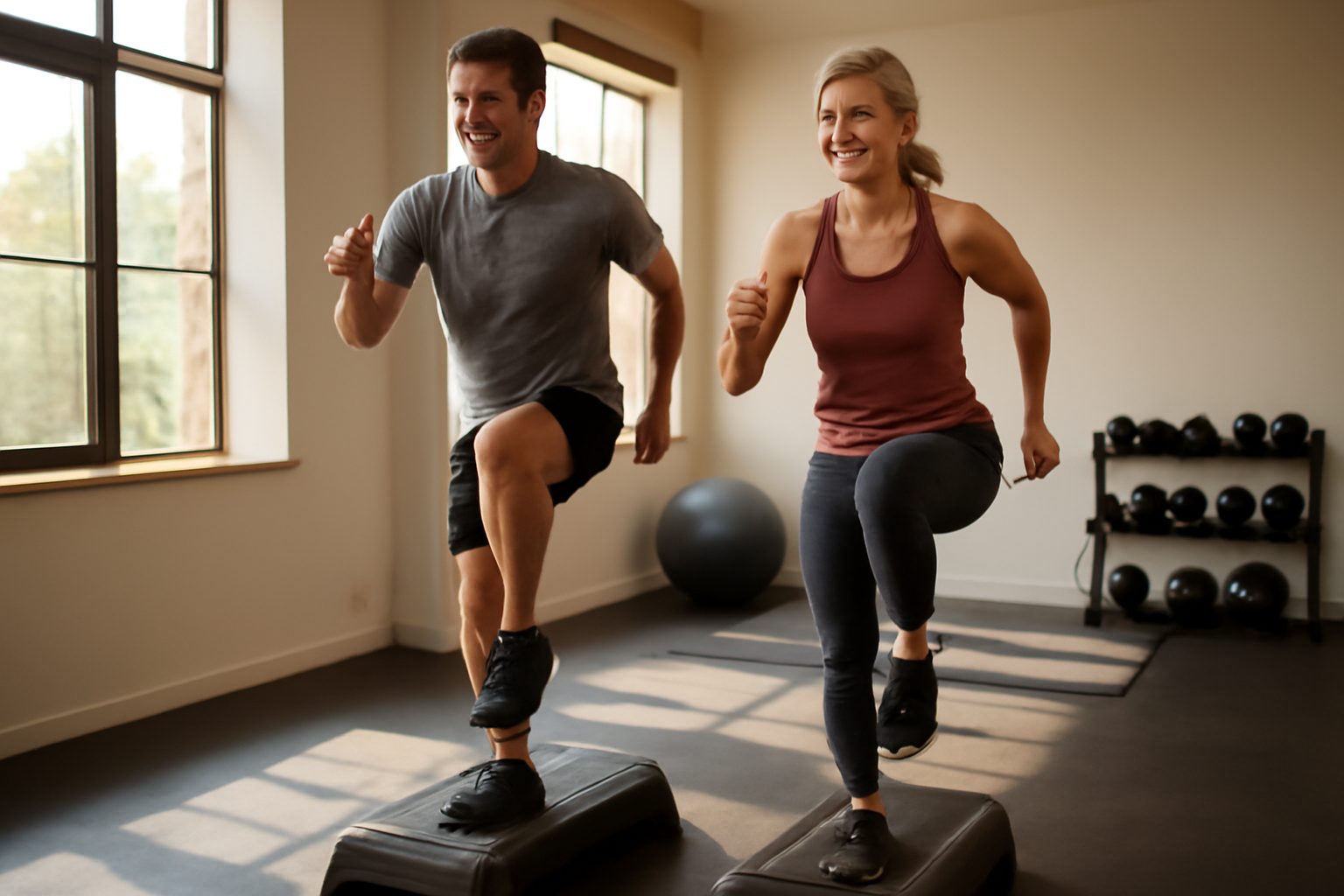
Phase 2 — Weeks 3-4 (Building): 20-25 minutes, two to three times per week. Increase work intervals to 40 seconds, keep recovery at 80 seconds. You can begin introducing bodyweight movements like modified squats, step-ups, or low-impact jumping jacks during the work interval if joint comfort allows.
Phase 3 — Weeks 5-8 (Progression): 25-30 minutes, three times per week. Work intervals reach 45 to 60 seconds, recovery drops to 60 seconds. Intensity should feel genuinely challenging but sustainable — you should be breathing hard, not gasping.
Always separate HIIT sessions with at least 48 hours of recovery. Your body needs that time to repair and adapt. Light activity like walking, yoga, or stretching on recovery days is encouraged. For guidance on building heart-healthy cardio habits that complement your HIIT program, see our guide on Cardio Exercise for Heart Health: The Complete Guide.
Sample Low-Impact HIIT Workout for Adults Over 40
The following 20-minute routine requires no equipment, is gentle on the joints, and is designed specifically for adults who are returning to exercise or managing mild orthopedic concerns. It follows a 40-second work / 20-second rest format.
Warm-up (5 minutes): Slow marching in place, arm circles, hip rotations, gentle leg swings, ankle rolls. Never skip this step — research suggests that warm-up significantly reduces the risk of muscle strain during high-intensity effort.
Circuit (perform twice):
- Wall sit (40 sec) — Rest (20 sec)
- Standing alternating knee raises (40 sec) — Rest (20 sec)
- Modified push-ups on knees or wall (40 sec) — Rest (20 sec)
- Side step touches (40 sec) — Rest (20 sec)
- Seated or standing bicycle crunches (40 sec) — Rest (20 sec)
Cool-down (5 minutes): Slow walking in place, standing quad stretch, seated hamstring stretch, deep breathing. Your heart rate should return toward baseline before you sit or lie down completely.
This session takes approximately 20 minutes and can be performed at home, at a gym, or even in a hotel room. As your fitness improves, you can increase the work intervals, add resistance bands, or graduate to more dynamic movements.
Living With a HIIT Routine: Consistency and Recovery
The most effective HIIT program is the one you actually stick with over months and years. Clinical evidence consistently shows that exercise adherence — showing up regularly over the long term — matters far more than any single workout’s intensity or design.
Adults over 40 are more susceptible to overtraining syndrome than younger exercisers because recovery takes longer with age. Signs of overtraining include persistent fatigue, declining performance, disrupted sleep, elevated resting heart rate, and increased irritability. These are signals to reduce intensity and volume, not push harder.
Nutrition plays a supporting role. Consuming adequate protein — the NIH recommends at least 0.8 grams per kilogram of body weight daily for adults, with some exercise physiologists suggesting higher amounts for active older adults — helps repair muscle tissue after HIIT sessions. Hydration before, during, and after exercise is equally important, as even mild dehydration impairs performance and increases injury risk.
Sleep is arguably the most underestimated recovery tool. The CDC reports that more than one-third of American adults regularly get fewer than seven hours of sleep per night. Poor sleep blunts the hormonal responses — including growth hormone release — that allow your body to fully benefit from exercise.
When to Call Your Doctor or Seek Emergency Care
While HIIT is generally safe for most adults over 40 when introduced appropriately, certain symptoms during or after exercise require immediate medical attention.
Call 911 or go to the emergency room immediately if you experience:
- Chest pain, pressure, tightness, or squeezing during or after exercise
- Pain radiating to your left arm, jaw, neck, or back
- Sudden severe shortness of breath that does not resolve with rest
- Fainting or near-fainting (syncope)
- An irregular or racing heartbeat accompanied by dizziness or chest discomfort
- Sudden severe headache unlike any you’ve experienced before
Schedule a non-emergency appointment with your doctor if you notice:
- Persistent joint pain lasting more than 48 hours after exercise
- Swelling in the lower legs or ankles following workouts
- Unexplained fatigue that does not improve with rest over several weeks
- Blood pressure consistently elevated after exercise sessions
- Any significant change in how your body feels during exertion compared to your baseline
Before beginning any new exercise program — especially one involving vigorous intensity — it is strongly recommended that adults over 40 who are sedentary, managing a chronic condition, or on prescription medications speak with their primary care physician first. This conversation takes less than ten minutes and can prevent serious complications.
Frequently Asked Questions About HIIT for Adults Over 40
How many days per week should adults over 40 do HIIT?
Most exercise physiologists and the American College of Sports Medicine recommend two to three HIIT sessions per week for adults over 40, with at least 48 hours of recovery between sessions. More frequent sessions without adequate recovery can increase injury risk and diminish results over time.
Can I do HIIT if I have high blood pressure?
This varies from person to person and depends significantly on whether your blood pressure is well-controlled with medication and lifestyle changes. Research suggests that moderate-intensity interval training can actually help lower blood pressure over time, but you should get your physician’s clearance before starting, particularly if your hypertension is uncontrolled or you are on multiple medications.
Is HIIT better than regular cardio for weight loss after 40?
Clinical evidence indicates that HIIT may produce slightly greater reductions in body fat — particularly visceral fat — than moderate-intensity continuous cardio in the same time period. However, both are beneficial, and the best choice is the one you will sustain consistently. Many adults find that combining HIIT two or three days per week with moderate cardio on other days produces the best results.
Do I need equipment to do HIIT at home?
No. Many effective HIIT routines for adults use only bodyweight movements such as squats, step touches, modified push-ups, and marching in place. Resistance bands, a stable chair, and a yoga mat can add variety but are not required to get started. The key variable is effort level, not equipment.
How long before I see results from HIIT?
Research suggests that measurable improvements in cardiovascular fitness and insulin sensitivity can appear within four to six weeks of consistent HIIT training. Visible changes in body composition typically take 8 to 12 weeks, depending on nutrition, sleep quality, and overall consistency. Individual variation is significant — some people respond faster, others more slowly.
Conclusion
HIIT is not a fad, and it’s not reserved for professional athletes or people half your age. For adults over 40, it represents one of the most evidence-backed, time-efficient strategies available for protecting metabolic health, preserving muscle, sharpening cardiovascular fitness, and supporting healthy aging from the inside out.
The key is starting smart — not hard. A gradual, well-structured approach guided by your current fitness level, any existing health conditions, and the input of your healthcare provider gives you the best chance of building a sustainable routine that delivers real, lasting results.
You don’t need to run sprints at 6 AM to benefit from interval training. You just need to start — safely, consistently, and with the understanding that every quality effort you make today is an investment in how well you move, feel, and function for decades to come.
This article is for informational and educational purposes only. It does not constitute medical advice, diagnosis, or treatment. Always consult your physician or a qualified healthcare provider before making changes to your health routine or treatment plan.
Medically reviewed by our editorial health team. Content follows evidence-based standards aligned with CDC and NIH guidelines.