Core Strength Training: The Complete Guide for Adults
A strong core is the foundation of every movement your body makes — and building it strategically can reduce pain, prevent injury, and transform your daily life.
Introduction
Meet David, 54, a project manager from Ohio who had dealt with nagging lower back pain for nearly a decade. He tried foam rollers, posture braces, and ergonomic chairs — but nothing seemed to help long-term. It wasn’t until his physical therapist recommended a structured core strength training program that he finally found lasting relief.
David’s story is far from unique. According to the National Institute of Neurological Disorders and Stroke (NINDS), low back pain affects approximately 80% of Americans at some point in their lives, and weak core musculature is among the most commonly cited contributing factors.
Despite being one of the most misunderstood concepts in fitness, core strength training is not just about getting six-pack abs. It’s about building a stable, functional midsection that supports everything you do — from lifting groceries to climbing stairs to playing with your grandchildren.
In this complete guide, you’ll learn exactly what core strength training involves, why it matters at every age, how to get started safely, and how to build a sustainable routine backed by clinical evidence.
What Is Core Strength Training?
The "core" refers to a complex system of muscles that stabilize and move the spine, pelvis, and ribcage. Most people think of the core as just the abdominals — the muscles you can see in the mirror — but that’s only part of the picture.
Your core includes:
- Rectus abdominis — the front abdominal wall, often called the "six-pack" muscle
- Transverse abdominis — the deep inner muscle that acts like a natural corset around your spine
- Internal and external obliques — muscles along your sides that control rotation and lateral movement
- Multifidus and erector spinae — deep back muscles that protect and move the spine
- Diaphragm and pelvic floor — the top and bottom of the "core canister" that regulate intra-abdominal pressure
- Glutes and hip flexors — often considered part of the functional core unit
Core strength training, therefore, is any exercise or movement practice specifically designed to build strength, stability, and coordination across this entire muscle group — not just the surface muscles.
According to a review published through the NIH’s National Library of Medicine, core stability training significantly improves functional movement, reduces chronic low back pain, and enhances athletic performance across all age groups. The evidence strongly supports making core work a regular part of adult fitness routines.
Signs Your Core May Need Strengthening
You don’t have to be in pain to benefit from core training. However, certain patterns suggest your core muscles may not be performing optimally.
Early or mild signs of core weakness:
- Lower back fatigue or discomfort after prolonged sitting or standing
- Difficulty maintaining an upright posture for extended periods
- Feeling unstable during single-leg activities like walking up stairs
- Hip or knee discomfort during exercise that isn’t traced to joint damage
- Difficulty breathing deeply during physical exertion
- General feeling of "stiffness" in the mid and lower back upon waking
More significant signs that warrant evaluation:
- Chronic low back pain that persists beyond 12 weeks
- Pelvic floor dysfunction (urinary leakage, pressure, or incontinence)
- Visible muscle imbalances, like one hip sitting higher than the other
- Recurring injuries to the lower back, hips, or knees
- Post-surgical rehabilitation needs affecting the abdomen or spine
A 2023 systematic review cited in the NIH database found that adults with poor core endurance were significantly more likely to develop musculoskeletal injuries over a 12-month period compared to those with adequate core stability. This underscores why early intervention matters.
If you experience sharp, radiating, or neurological symptoms such as numbness or tingling down one leg, consult a physician before starting any core training program.
Causes and Risk Factors for a Weak Core
Core weakness doesn’t develop overnight. It typically results from a combination of lifestyle factors, age-related changes, and sometimes medical conditions.
Lifestyle contributors:
- Prolonged sitting — Research from the American Journal of Epidemiology suggests Americans sit an average of 6 to 8 hours daily. Extended sitting deactivates core stabilizers and shortens hip flexors, both of which compromise core function over time.
- Sedentary behavior — Muscles that aren’t regularly challenged will weaken through a process called disuse atrophy.
- Poor breathing mechanics — Chest breathing, rather than diaphragmatic breathing, reduces activation of the deep core muscles.
- Repetitive movement patterns — Many jobs and sports involve unilateral (one-sided) movements that can create asymmetries in core strength.
Age-related factors:
- After age 30, adults naturally begin losing muscle mass in a process called sarcopenia — the gradual, age-related loss of skeletal muscle. According to the CDC, adults can lose 3 to 8% of muscle mass per decade after 30, and the rate accelerates after age 60.
- Hormonal changes, particularly declining estrogen and testosterone, further affect muscle maintenance in adults over 50.
Medical and structural risk factors:
- Pregnancy and postpartum recovery (diastasis recti, or abdominal separation)
- Prior abdominal or spinal surgeries
- Conditions like scoliosis, osteoporosis, or degenerative disc disease
- Obesity — excess abdominal weight shifts the center of gravity, increasing the demand on core structures
The good news is that most risk factors are addressable with consistent, appropriately designed training. This varies from person to person, so working with a qualified professional is especially important when health conditions are involved.
Getting Assessed: What to Expect Before You Start
Before beginning a core strength training program, especially if you have a history of back pain, surgery, or other musculoskeletal conditions, a brief assessment can help you start safely and effectively.
Who to see:
- Primary care physician — for medical clearance, especially with back pain history or chronic illness
- Physical therapist — for a functional movement assessment and personalized program design
- Certified personal trainer (preferably NSCA, ACSM, or NASM credentialed) — for exercise programming in generally healthy adults
Common assessments used clinically:
- McGill’s Core Endurance Tests — a series of timed holds (plank, side bridge, Biering-Sorensen) that measure endurance across different core muscle groups
- Functional Movement Screen (FMS) — evaluates movement quality and detects asymmetries that might increase injury risk
- Single-leg stance test — assesses balance and hip/core coordination
Imaging such as X-rays or MRIs is generally not needed before starting a beginner core program unless you have specific symptoms like nerve pain, significant trauma history, or unexplained pain that has not responded to conservative care.
The American College of Sports Medicine (ACSM) recommends that most healthy adults can begin low-to-moderate intensity exercise programs without medical testing. However, when in doubt, consult your doctor first.
Core Strength Training: Evidence-Based Exercises and Approaches
One of the most important principles in core training is progressive overload — gradually increasing the challenge over time to continue stimulating strength gains. Starting too hard leads to compensation and injury; staying too easy leads to no adaptation.
Here’s a structured breakdown of core training approaches appropriate for adults at different levels:
Level 1: Foundation (Beginners and Those Recovering from Pain)
The goal at this stage is to activate and coordinate the deep core muscles — particularly the transverse abdominis and multifidus — before adding load or complexity.
- Diaphragmatic breathing — lying on your back, inhaling to expand the belly (not the chest), and exhaling with control. This activates the core canister at the base level.
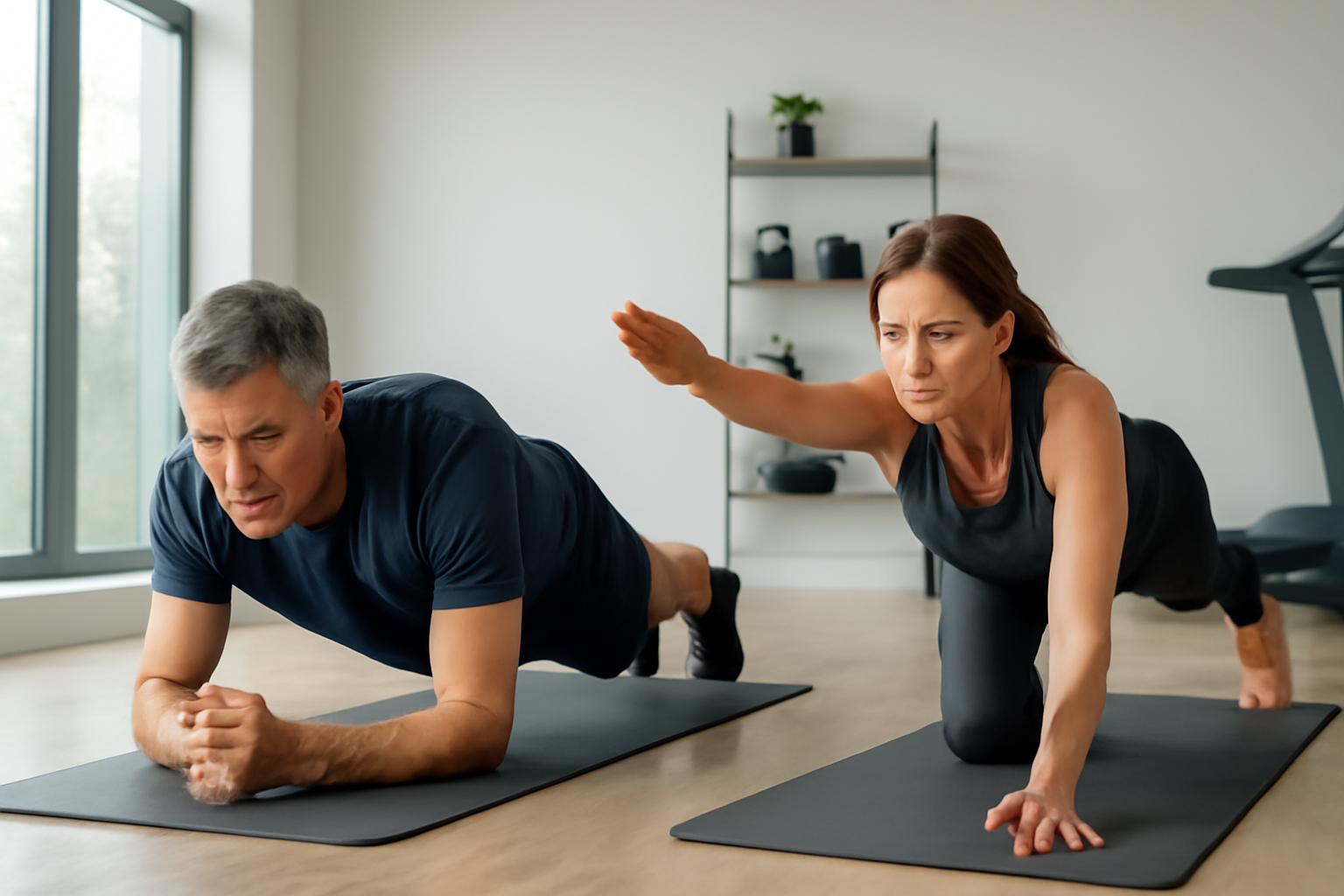
- Dead bug — lying on your back, arms extended toward the ceiling, lowering alternating arm and leg while maintaining a flat lower back. Excellent for deep core activation without spinal loading.
- Bird dog — on hands and knees, extending opposite arm and leg while keeping the spine neutral. Research cited by the NIH supports bird dog as one of the most effective low-load core exercises for reducing back pain.
- Glute bridge — lying on your back with knees bent, lifting the hips while engaging the glutes and core. Addresses the posterior chain, which is often neglected.
- Modified plank (knees down) — building anterior core endurance without excessive lumbar stress.
Level 2: Building Stability (Intermediate)
Once foundation exercises feel controlled and pain-free, you can progress to more demanding stability challenges.
- Full forearm plank — holding 20 to 60 seconds with proper form: neutral spine, engaged glutes, no hip sagging or piking
- Side plank — trains the lateral core (quadratus lumborum, obliques), critical for spinal protection during rotational movements
- Pallof press — using a resistance band or cable, pressing straight out from the chest while resisting rotation. Highly functional and evidence-supported for anti-rotation strength.
- Single-leg glute bridge — progressed from the bilateral version, adding hip stability demands
- Hollow body hold — a gymnastics-inspired exercise that trains anterior core control with full-body integration
Level 3: Dynamic and Functional Core Training (Advanced)
At this level, core training becomes integrated with whole-body movements — which is where the most real-world benefit occurs.
- Turkish get-up — a full-body movement requiring core strength, shoulder stability, and coordination through multiple planes
- Cable woodchop — diagonal pulling/pushing across the body to train rotational power
- Loaded carries (farmer’s carry, suitcase carry) — walking with weight challenges the core isometrically in a highly functional way
- Deadlifts and squats — when performed with proper bracing technique, compound lifts are among the most powerful core-strengthening movements available
- Medicine ball rotational throws — for rotational power and real-world athletic demand
A 2022 meta-analysis published through the NIH found that core stability training performed 3 to 5 times per week for at least 8 weeks significantly reduced pain intensity and disability in adults with chronic low back pain compared to general exercise alone. Clinical evidence indicates that both frequency and consistency matter more than any single exercise choice.
For more comprehensive fitness strategies that complement core training, you may find it helpful to explore our guide on Functional Fitness Training: The Complete Guide for Adults, which covers how core strength fits into real-world movement patterns.
Living With a Stronger Core: Day-to-Day Integration
The most effective core training isn’t just what you do in the gym — it’s the habits you build throughout the day.
Practical strategies to reinforce core strength daily:
- Practice bracing during lifting — whether picking up a bag of groceries or a dumbbell, inhale, brace your core gently (like you’re bracing for a punch), then lift. This protects your spine every time.
- Upgrade your sitting habits — try sitting at the edge of your chair with feet flat and spine upright for short periods. This activates core muscles passively. Standing desks used alternately with sitting can also help.
- Walk with intention — engage your core lightly during walks by maintaining an upright posture and avoiding forward hip tilt. Walking is underrated as a core-activating activity.
- Practice belly breathing during stress — diaphragmatic breathing is a core exercise you can do anywhere, anytime.
- Prioritize sleep and recovery — muscles grow and repair during rest. According to the NIH, adults who sleep fewer than 7 hours per night have higher rates of musculoskeletal pain and slower recovery from exercise.
Nutrition for core muscle development:
Building core muscle — like all skeletal muscle — requires adequate protein intake. The American College of Sports Medicine and the Academy of Nutrition and Dietetics jointly recommend that active adults consume 1.2 to 2.0 grams of protein per kilogram of body weight per day to support muscle repair and growth. Prioritizing whole food protein sources (lean meats, fish, eggs, legumes, dairy) alongside resistance training creates the best environment for muscle development.
If you’re also working on lower-body strength to complement your core routine, consider reviewing our guide on Strength Training After 50: The Complete Guide for age-appropriate programming strategies.
When to Call Your Doctor or Seek Emergency Care
Core training is safe for the vast majority of adults. However, certain symptoms require immediate medical attention or should prompt a conversation with your physician before continuing exercise.
🚨 Seek emergency care immediately if you experience:
- Sudden, severe abdominal or back pain with no prior history
- Pain radiating down one or both legs accompanied by bladder or bowel changes (possible cauda equina syndrome — a medical emergency)
- Chest pain, pressure, or shortness of breath during exercise
- Loss of consciousness or extreme dizziness during activity
- Sudden severe headache during exertion
Schedule an appointment with your doctor if:
- Low back pain has persisted longer than 4 to 6 weeks without improvement
- You experience significant pain during specific core exercises that doesn’t resolve with rest
- You notice pelvic floor symptoms (leaking urine, pressure, or heaviness during exercise)
- You’ve had recent abdominal surgery and want to begin core rehabilitation
- You’re postpartum and experiencing abdominal separation (diastasis recti)
- You have osteoporosis and are unsure which exercises are safe for your bone density
At your next appointment, consider mentioning:
- Your current fitness level and what you’re hoping to achieve
- Any pain, discomfort, or restrictions you notice during movement
- A list of the exercises you’re doing so your provider can flag any that may be contraindicated for your specific health history
Frequently Asked Questions
Q: How often should I train my core to see real results?
Most fitness professionals and clinical research suggest 3 to 5 core training sessions per week is optimal for adults. Unlike large muscle groups that need 48 hours of recovery, lower-intensity core work (like planks and bird dogs) can often be performed daily without overtraining. However, higher-load core exercises should include recovery days. Consistency over weeks and months matters far more than any single session.
Q: Can core training actually help with chronic lower back pain?
Research suggests yes — with important caveats. A landmark meta-analysis reviewed by the NIH found that targeted core stability training significantly reduced chronic low back pain in adults over an 8 to 12 week period. However, not all back pain is the same. Some types of pain require specific rehabilitation protocols rather than general core training. Always get a proper diagnosis before treating back pain with exercise on your own.
Q: Is it safe to do core exercises with osteoporosis?
Many core exercises are safe and beneficial for people with osteoporosis, but certain movements — particularly ones involving spinal flexion (like crunches and sit-ups) — are generally discouraged due to the risk of vertebral compression fractures. The National Osteoporosis Foundation recommends focusing on exercises that involve spinal extension, lateral movement, and balance. Consult your physician or a physical therapist before starting, as exercise selection should be individualized based on your bone density and fracture risk.
Q: Are sit-ups and crunches the best core exercises?
Despite being the most well-known core exercises, sit-ups and traditional crunches are not considered optimal by most sports medicine specialists today. They heavily recruit the hip flexors, place compressive load on lumbar discs, and do relatively little to activate the deep stabilizing muscles. Clinical evidence indicates that exercises like the dead bug, bird dog, plank variations, and loaded carries provide superior core activation with lower injury risk — particularly for adults with any history of back issues.
Q: How long before I notice results from core training?
Most people begin to notice functional improvements — better posture, reduced back fatigue, easier movement — within 4 to 6 weeks of consistent training. Visible changes in muscle tone typically take 8 to 12 weeks or longer, depending on body composition and training intensity. Neurological adaptations (how efficiently your brain activates your muscles) often come first and account for many of the early-stage strength gains. This varies from person to person based on age, starting fitness level, nutrition, and recovery quality.
Conclusion
Core strength training is one of the most evidence-supported investments you can make in your long-term health and physical function. Whether you’re a 35-year-old desk worker, a 58-year-old managing back pain, or a 68-year-old focused on staying independent and active, building a stronger core changes how your body feels and performs every single day.
The key is starting where you are, progressing gradually, and choosing exercises that match your current ability and health status. You don’t need an hour in the gym — even 15 to 20 focused minutes, three to five times a week, can produce meaningful, lasting results over time.
Most importantly, treat your core training as part of a broader health strategy — not a quick fix. Work with your physician and, when needed, a physical therapist or qualified trainer to build a program that’s right for your body and your goals.
Your core has supported every movement you’ve made your entire life. It’s never too late to start giving it the attention it deserves.
Medical Disclaimer: This article is for informational and educational purposes only. It does not constitute medical advice, diagnosis, or treatment. Always consult your physician or a qualified healthcare provider before making changes to your health routine or treatment plan.
Medically reviewed by our editorial health team. Content follows evidence-based standards aligned with CDC and NIH guidelines.